


Gruhapravesham
Gruhapraveshamగృహప్రవేశం
What the ceremony actually is, the sequence in order, what your family needs to arrange, and honest answers to the things people worry about. Written for Telugu households in Andhra Pradesh and Telangana.
What a gruhapravesham actually does
A gruhapravesham is not a housewarming party with a puja attached. It is the rite by which a structure of brick and cement becomes a dwelling fit for a family to live in.
Three things happen, and the order matters. Punyahavachanam purifies the space and the people in it. Vastu Shanti addresses the building itself — settling the Vastu Purusha understood to reside within the structure, and quieting whatever imbalance the construction left behind. Griha pravesha proper is the family entering for the first time as residents, marked by the milk boiling over.
Around these sit the parts that vary by family and by scale — Ganapati puja at the outset, Navagraha Shanti, Kalasha Sthapana, go-puja where it is possible, a Vastu Homam where space and the muhurtham allow, and Satyanarayana Vratam to close. What does not vary is the sankalpa: the formal statement of who is performing the rite, in which gotra, on which tithi and nakshatram, and for what purpose. A gruhapravesham without a properly made sankalpa is incomplete however elaborate everything around it is.

Our pujari on what the ceremony is actually for — including whether it applies to a rented home. 5 min, Telugu.
Three kinds of gruhapravesham
The classical texts distinguish three cases. Most families are in the first, but the other two are common enough that it is worth knowing they are provided for.
Apurva
A newly built house, entered for the first time. The most common case, and the fullest form of the ceremony.
అపూర్వSampurva
Returning to a house after a long absence — a posting abroad, an extended stay elsewhere.
సంపూర్వDvandva
Re-entering after rebuilding or major renovation, or after fire, flood or damage forced you out.
ద్వంద్వWhat happens, in order
This is the fuller Telugu sequence. A smaller ceremony leaves out the homams and compresses the middle, but the shape stays the same.
The house is prepared, the night before మామిడి తోరణం
Cleaned and washed, mango-leaf toranam at the door, muggu drawn at the threshold. Traditionally nobody enters to live before the muhurtham.
Dwara puja and go-puja at the threshold ద్వార పూజ
Worship at the main door before entering. A turmeric-and-kumkum smeared ash gourd is broken at the threshold, and a coconut broken with both halves set either side of the door.
The family enters గృహ ప్రవేశం
The head of the household enters first, carrying the ishta daivam — commonly Ganesha, Lakshmi, Venkateswara or Satyanarayana Swamy.
Milk is boiled over పాలు పొంగించడం
Fresh cow's milk in a new vessel, boiled until it rises and spills. The moment everyone remembers, and the one people ask most about.
Ganapati puja and Punyahavachanam పుణ్యాహవాచనం
Obstacles removed at the outset, then the purification of the house and the people in it. The Kalasha is established during this block.
Sankalpam సంకల్పం
The formal statement of who is performing the rite, in which gotra, on which tithi and nakshatram, and for what purpose. Without a properly made sankalpa the rest is incomplete.
Navagraha puja నవగ్రహ పూజ
Settling the planetary influences on the family entering the house.
Vastu Shanti and the homams వాస్తు శాంతి
The centre of the ceremony. Offerings are made to the eight directions, to Bhudevi and to the Vastu Purusha said to reside in the structure. Vastu Homam, and where the scale allows, Ganapati and Navagraha Homam.
Poornahuti పూర్ణాహుతి
The concluding offering into the fire.
Satyanarayana Vratam సత్యనారాయణ వ్రతం
Commonly performed to close a Telugu gruhapravesham, though not every family includes it.
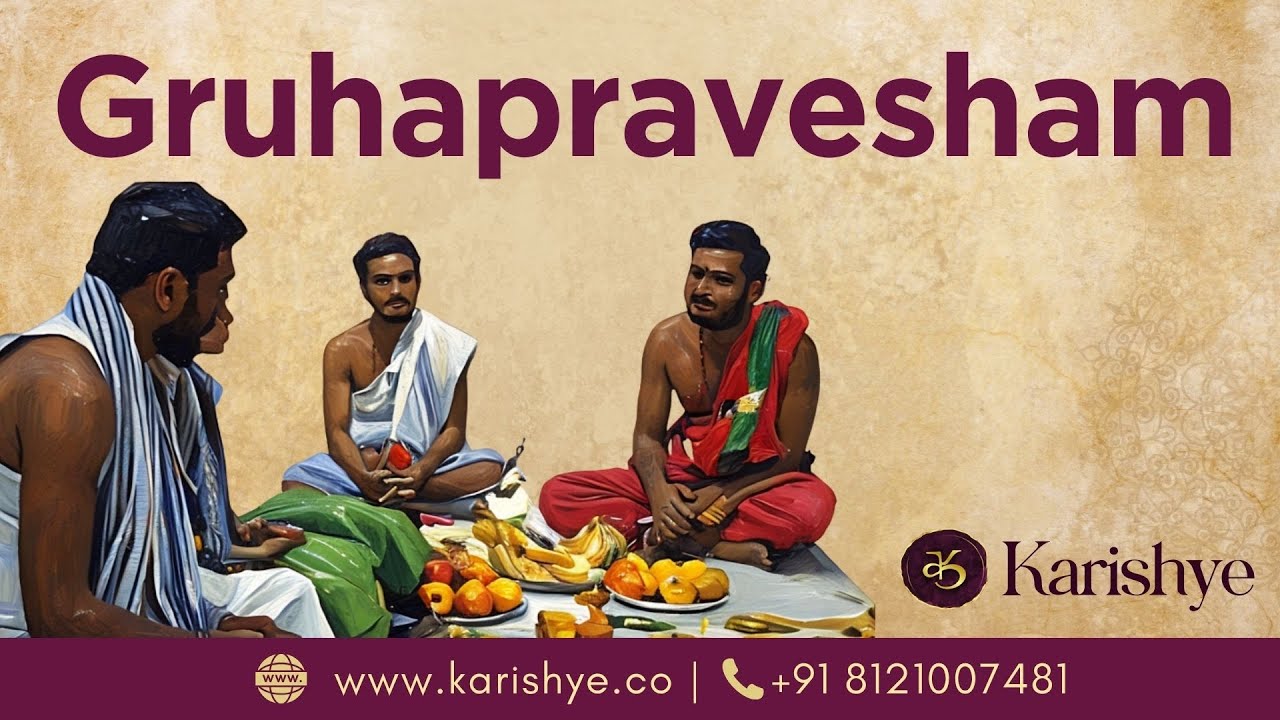
What the sequence above looks like on the day, filmed at a family’s gruhapravesham.
It is the part of the ceremony people ask about more than any other — why fresh cow's milk, why a new vessel, why it must be allowed to spill rather than caught. We have written about it separately.
Who brings what
The most common cause of a stressful morning is discovering at 6am that something on the household side was never arranged. This is the split.
The pujari brings
- Turmeric, kumkum, sandalwood · పసుపు, కుంకుమ, గంధం
- Kalasham and the vastralu · కళశం
- Homam samidhalu and ghee · సమిధలు, నెయ్యి
- Navadhanyalu — the nine grains · నవధాన్యాలు
- Navagraha vastralu · నవగ్రహ వస్త్రాలు
- Dhoti for the pujari · ధోతి
- The general puja samagri
Your family arranges
- A NEW vessel for the milk — not one you've cooked in · కొత్త గిన్నె
- Fresh cow's milk, and a working stove at the spot · ఆవు పాలు
- Coconuts — one per interior door, plus the threshold · కొబ్బరి కాయలు
- An ash gourd for the threshold, and a second to hang · గుమ్మడికాయ
- Photos or idols of your ishta daivam
- Betel leaves, flowers, fruit · తమలపాకులు, పూలు
- Rice, jaggery, camphor, matches · బియ్యం, బెల్లం
- Plates, trays, a low table for the deities
- Your gotra and the nakshatram of the head of the household
A genuinely new vessel for the milk — not a pot you have cooked in — and a working stove or gas connection at the spot where it will be boiled. Both are assumed, and both are discovered missing on the morning.
Note that item lists vary between pujaris. Ask when you book, rather than assuming this list matches whoever is coming.
Choosing the date, and why the calendar looks empty
If you have been hunting for a gruhapravesham date and finding nothing your elders will accept, there is a structural reason. Several periods are set aside in Telugu practice, and in some years they stack up.
Moudyami
When Guru (Jupiter) or Shukra (Venus) passes close enough to the Sun to be lost from view, the planet is said to be combust. During these windows, gruhapravesham, marriage, upanayanam and house construction are all traditionally set aside. These are astronomical events, so the windows are not a matter of opinion — but different panchangams calculate their exact boundaries differently, which is why you will see conflicting dates online.
Mahalaya Paksham
The fortnight given to the ancestors, falling in Bhadrapada masam around late September and early October. New beginnings are not undertaken during it.
Ashada masam
Widely avoided in Andhra Pradesh, Telangana and Karnataka. Worth being precise here: this is a regional custom rather than a scriptural rule — it is not observed the same way in Maharashtra or Gujarat. The reasons usually given are the start of Chaturmasya and, practically, the monsoon.
Maagham, Shravanam and Kartikam are the months classically favoured for gruhapravesham. In most years the calendar opens up properly again from Kartika masam onward.
Several popular muhurtham tools will show you gruhapravesham dates inside the periods described above. They arrive at them by checking tithi, nakshatram and weekday alone, without applying the Moudyami or masam exclusions that Telugu families actually observe. We have deliberately not published a date list for the same reason — a muhurtham depends on your gotra and your nakshatram, and it should come from a pujari looking at your family's particulars, not from a calculator.
Send us the window you are working within and we will have one looked at properly.

A family describes how their gruhapravesham was arranged, start to finish.
The questions people actually ask
Can gruhapravesham be done after we've already moved in?
Yes, and a great many families do. When possession dates, school terms or a landlord's notice do not line up with a muhurtham, families move in and perform the ceremony on the next auspicious date. The pujari adds a short prayaschitta sankalpa at the start to account for the order of things. This is far better than forcing the ceremony onto a day that does not suit the family.
Is gruhapravesham needed for a rented house?
The sankalpa is made for the family entering and dwelling in the space, not for ownership of it. So yes, it applies — and Punyahavachanam and Vastu Shanti are performed as they would be in an owned home. What usually changes is scale: a homa may need to be small or moved to a balcony, and many societies restrict open flame. Some families in rented homes perform only the milk boiling and a short puja, which is a legitimate choice.
Can we sleep in the new house before the gruhapravesham?
Traditionally the house is not lived in before the ceremony. In practice families often move belongings in beforehand and sleep elsewhere until the muhurtham. After the ceremony, the family is expected to stay in the house for three consecutive nights.
Can it be done without a homam?
Yes. A gruhapravesham at its smallest is Punyahavachanam, Vastu Shanti and the entry with the milk boiling. The homam is the part that scales — Vastu Homam, then Ganapati and Navagraha Homam as the occasion grows. Apartments with open-flame restrictions are the most common reason to leave it out, and the ceremony remains complete without it.
Can a pregnant woman take part?
There is no prohibition on a pregnant woman being present or participating. Families sometimes ask her not to sit near the homa kunda for comfort and smoke rather than for any ritual reason. If this matters to your family, say so when booking and the pujari will arrange the seating accordingly.
Which direction should the milk boil over towards?
The vessel is placed on the stove in the kitchen and the milk allowed to rise and spill on its own — the direction it overflows is read by some families as a sign, but there is no rule requiring you to force it one way. What matters is that the milk is fresh, the vessel is new, and it is allowed to boil over rather than being caught.
What if there is no muhurtham that suits us?
Tell us the window you are working within along with your gotra and the nakshatram of the head of the household, and a pujari will look at it properly against the panchangam. There are usually more options than a generic calendar suggests, because a muhurtham depends on your family's particulars and not only on the date.
Is gruhapravesham the same as Vastu Shanti?
Not quite. Vastu Shanti is one part of a gruhapravesham — the part addressed to the dwelling itself and to the Vastu Purusha. A gruhapravesham is the whole sequence, of which Vastu Shanti is the centre. Vastu Shanti can also be performed on its own for a house you already live in.
How long does it take?
A short ceremony without a full homam runs around two to three hours. With Vastu Homam and the fuller sequence, four to five hours is normal. A large gruhapravesham in an independent house with multiple ritwiks can take most of the day.
Is it gruhapravesham or gruhapravesam?
Both, and you will also see griha pravesham and griha pravesh. గృహప్రవేశం transliterates several ways and no spelling is wrong. Telugu families most often write gruhapravesham or gruhapravesam; griha pravesh is the North Indian form of the same ceremony, which differs in some customs.
Read before the day
Most families have a few questions before arranging anything, and that is completely fine. Message or call us and we will talk it through with you first — muhurtham, what is involved and what it costs — at no charge and with no obligation.
Telugu and English. We will not add you to any list or chase you afterwards.